
Part I, The Work
At a Glance
- Artist
- Andy Warhol, 1928-1987
- Title
- Committee 2000
- Date
- 1982
- Medium
- Original colour screenprint on Lenox Museum Board
- Edition
- Numbered 1198/2000 in pencil
- Signature
- Hand-signed by the artist in pencil
- Printer
- Rupert Jasen Smith, New York (embossed blind stamp)
- Publisher
- Committee 2000, Munich
- Catalogue Raisonné
- Frayda Feldman & Jörg Schellmann, Andy Warhol Prints, FS II.289
- Framed Dimensions
- 102 x 77 cm
- Condition
- To be confirmed
- Gallery Price
- Price on Application
Opening Reflection
Every generation produces artists who redefine the way we see the world. For the second half of the twentieth century, that artist was Andy Warhol. Through painting, printmaking, photography and film, he transformed the visual language of modern culture, challenging long-held distinctions between fine art and everyday life.
Committee 2000 belongs to the final chapter of Warhol's career, a period in which decades of experimentation had refined his artistic language into images of extraordinary confidence and clarity. Created in 1982 for a cultural initiative looking towards the arrival of the new millennium, the print reflects an era of optimism while demonstrating Warhol's enduring fascination with communication, progress and the power of images to shape public consciousness.
More than forty years after its publication, Committee 2000 remains a compelling example of Warhol's mature printmaking. Beyond its immediate visual appeal, the image captures the optimism of its age while demonstrating the versatility of an artist whose influence continues to shape contemporary art, design and popular culture.
Monograph Overview
This monograph examines Committee 2000 within Andy Warhol's late career and considers its place in the development of Pop Art and twentieth-century printmaking. It traces the development of Warhol's artistic vision, the role of screenprinting as a creative medium and the continuing influence of Pop Art on contemporary visual culture. It also considers the edition's creation and publication, its relationship to Warhol's wider graphic oeuvre and the qualities that continue to attract collectors to signed lifetime impressions.
Produced as part of the Ewan Macfarlane Gallery Collector's Monograph Series, this publication has been written to encourage informed collecting through scholarship, historical context and connoisseurship, offering readers a deeper understanding of both the artwork and the artist who created it.
An Introduction: Andy Warhol and Committee 2000
Few artists transformed twentieth-century art as profoundly as Andy Warhol. More than any other figure, he dissolved the traditional boundaries between fine art, popular culture and commercial design, creating a visual language that remains instantly recognisable more than half a century later.
Published in 1982, Committee 2000 belongs to Warhol's mature period, when his command of screenprinting was exceptionally assured. Commissioned by the Munich-based Committee 2000 to support a cultural initiative looking towards the new millennium, the work demonstrates Warhol's ability to create images that are simultaneously bold, elegant and immediately accessible.
The print reflects the confidence and technical assurance of Warhol's mature practice. Every element, from its vibrant colour and crisp graphic composition to its exceptional production quality, demonstrates the refinement that characterised his later editions. Printed by Rupert Jasen Smith, the master printer responsible for many of Warhol's finest screenprints, and published in a controlled edition of 2,000 impressions, it stands as an important example of the artist's mature graphic work.
More than four decades after its publication, Committee 2000 continues to resonate because it embodies many of the qualities that define Warhol's enduring appeal: visually immediate yet intellectually sophisticated, historically significant yet unmistakably contemporary.
Significance of the Work
Within Warhol's extensive graphic oeuvre, Committee 2000 occupies an unusual position. Its subject is neither a celebrity nor a consumer object, but a still life created in association with an organisation looking towards the approaching millennium. This gives the edition a distinct character within his later work: celebratory without being commemorative, and optimistic without relying upon conventional symbols of technological progress.
Commissioned by the Munich-based Committee 2000, the edition was produced to raise funds for projects anticipating the arrival of the new millennium. Rather than promoting a commercial product or celebrating celebrity culture, Warhol applied his unmistakable visual language to an initiative centred upon optimism, progress and international cooperation.
From a collector's perspective, the edition possesses many of the qualities associated with Warhol's most desirable lifetime prints. It was produced in a controlled edition of 2,000 impressions, individually signed by the artist in pencil, printed by his long-standing collaborator Rupert Jasen Smith and published on premium Lenox Museum Board. Each impression bears Smith's embossed blind stamp and is documented in the catalogue raisonné by Frayda Feldman and Jörg Schellmann (FS II.289).
Unlike many artists whose late work represents a decline, Warhol's final decade is widely regarded as one of remarkable creative energy. Committee 2000 exemplifies this period of artistic maturity, making it an important work within both his graphic output and the wider history of Pop Art.

Part II, The Artist
Art in Context
Pop Art transformed the relationship between fine art and modern visual culture. Emerging during the late 1950s and flourishing throughout the 1960s, it challenged the long-held belief that fine art should concern itself only with grand historical subjects, personal expression or abstract form. Instead, artists turned their attention to the imagery of everyday life: advertisements, comic books, newspapers, product packaging, film stars and television.
Rather than rejecting popular culture, Pop artists embraced it. They recognised that modern society was increasingly shaped by mass communication, consumerism and branding. Images once considered ordinary or disposable became the raw material for a new artistic language that reflected the realities of contemporary life.
Among these artists, Andy Warhol emerged as the movement's defining figure. Through screenprinting, repetition and bold colour, he transformed familiar images into works of art that questioned originality, celebrity, commercialism and the nature of artistic authorship itself.
“They always say time changes things, but you actually have to change them yourself.”
— Andy Warhol, The Philosophy of Andy Warhol (From A to B and Back Again)
Before Warhol
Although revolutionary, Warhol's work did not emerge in isolation. The movement that immediately preceded Pop Art was Abstract Expressionism, dominated by artists including Jackson Pollock, Mark Rothko, Willem de Kooning and Barnett Newman. These painters viewed art as an intensely personal form of emotional expression; monumental canvases, expressive gestures and abstraction defined the post-war American art world during the 1940s and 1950s.
Warhol emerged in a culture dominated by these artists but developed a markedly different visual language. Rather than foregrounding expressive gesture, he turned towards the reproduced imagery of advertising, publishing and mass media. His early career as a successful commercial illustrator profoundly influenced this development: the worlds of advertising, magazine publishing and graphic design provided the visual vocabulary that would later become central to Pop Art.
Alongside Warhol
Warhol was part of an extraordinary generation of artists who collectively redefined contemporary art. His contemporaries included Roy Lichtenstein, Claes Oldenburg, James Rosenquist, Tom Wesselmann, Robert Indiana, Richard Hamilton, Peter Blake and David Hockney. Each explored aspects of popular culture in different ways: Lichtenstein appropriated the visual language of comic books, Oldenburg monumentalised everyday objects, Hamilton examined consumer society and Hockney combined elements of Pop with portraiture, landscape and an increasingly personal visual language.
Yet Warhol remained unique. His fascination with celebrity, repetition and mechanical production fundamentally changed the relationship between art and mass media, making him the defining voice of Pop Art.
After Warhol
Few twentieth-century artists have exercised a greater influence upon later generations. Warhol's ideas continue to resonate throughout contemporary art and visual culture, and his influence can be seen in artists such as Jeff Koons, Damien Hirst, Takashi Murakami, Banksy, Richard Prince and KAWS. Beyond the art world, his impact extends into fashion, music, advertising, photography and digital culture. Branding, celebrity, repetition and image-making, all central to Warhol's practice, have become defining characteristics of the twenty-first century.
Why Warhol Matters
Andy Warhol did not simply change the appearance of modern art. He changed the questions that artists asked. Before Warhol, originality was often understood as creating something entirely new by hand. Warhol challenged this assumption by embracing mechanical processes, repetition and imagery borrowed from everyday life, inviting audiences to reconsider what constitutes originality, authenticity and artistic value.
His work also anticipated many of the defining characteristics of contemporary society. Long before the emergence of social media, Warhol recognised the growing importance of branding, image, fame and mass communication. Today, his work remains remarkably contemporary because it speaks directly to a world saturated with images. Rather than documenting modern life, he anticipated it.
Approaching Warhol's Work
Many people first encounter Andy Warhol's work with a simple question: why is this art? The answer lies not in technical display alone, but in the relationship between image, process and idea. Warhol was never attempting to demonstrate technical virtuosity in the traditional sense. Instead, he challenged viewers to reconsider the visual world around them, encouraging audiences to question why some images are celebrated while others are ignored, why certain individuals become cultural icons, and how repetition changes the way we perceive meaning.
Viewed in this way, Committee 2000 becomes more than a bold and colourful screenprint. It becomes a reflection upon communication, optimism and the visual language of an era looking towards the future.
Part III, The Medium
Understanding the Medium
Committee 2000 is an original hand-signed colour screenprint, produced during Andy Warhol's lifetime using the medium that became synonymous with his artistic practice. Far from being simply a method of reproduction, screenprinting was central to Warhol's creative vision. He embraced the process because it reflected the visual language of the modern world: advertising, newspapers, magazines and commercial printing. By employing a technique capable of producing multiple impressions, Warhol deliberately challenged traditional ideas of originality while demonstrating that works created through mechanical processes could possess the same artistic significance as unique paintings.
Printed on Lenox Museum Board, a substantial support frequently used for Warhol's later editions, the work displays the high production standards associated with his mature screenprints. Each impression was individually signed by Andy Warhol in pencil, forming an integral part of the edition's identification and authentication. Together with the edition number, printer's blind stamp and catalogue raisonné reference, the signature forms an essential part of the work's authenticity and historical importance.
The Screenprinting Process
Screenprinting is one of the most important printmaking techniques of the twentieth century and became the defining medium of Andy Warhol's career. The process begins with a fine mesh screen stretched tightly across a rigid frame. Areas that are not intended to print are blocked, leaving selected sections of the mesh open for ink to pass through. Each colour requires its own individual screen, carefully aligned so that successive layers build the final image.
For complex editions such as Committee 2000, numerous screens would have been prepared, each carrying a different element of the composition. Individual colours were printed separately, allowing remarkable precision while preserving the richness and vibrancy for which Warhol's work is celebrated. Although the process is capable of producing consistency across an edition, each impression retains subtle variations resulting from the manual printing process - part of the character of original screenprints and their individuality as works of art.
The Making of the Edition
The production of Committee 2000 brought Warhol together with Rupert Jasen Smith, one of his principal print collaborators during the 1970s and 1980s. The edition was printed in New York by Smith, whose workshop collaborated with Warhol on many of his most celebrated graphic works during this period and was renowned for its meticulous technical standards. This impression bears Smith's embossed blind stamp, providing an additional mark of authenticity and craftsmanship.
Published in Munich by Committee 2000, the edition was produced to support a cultural initiative looking towards the arrival of the new millennium. The edition was strictly limited to 2,000 impressions, each individually signed by Andy Warhol in pencil; this impression is numbered 1198/2000. The work is fully documented in the catalogue raisonné by Frayda Feldman and Jörg Schellmann as FS II.289, confirming its place within Warhol's authenticated body of original prints.
The combination of Warhol's hand signature, Rupert Jasen Smith's distinguished workshop, publication during the artist's lifetime and inclusion within the recognised catalogue raisonné firmly establishes Committee 2000 as an original work of graphic art and an important example of Warhol's mature printmaking.
Part IV, Seeing the Artwork
Looking Beyond the Image
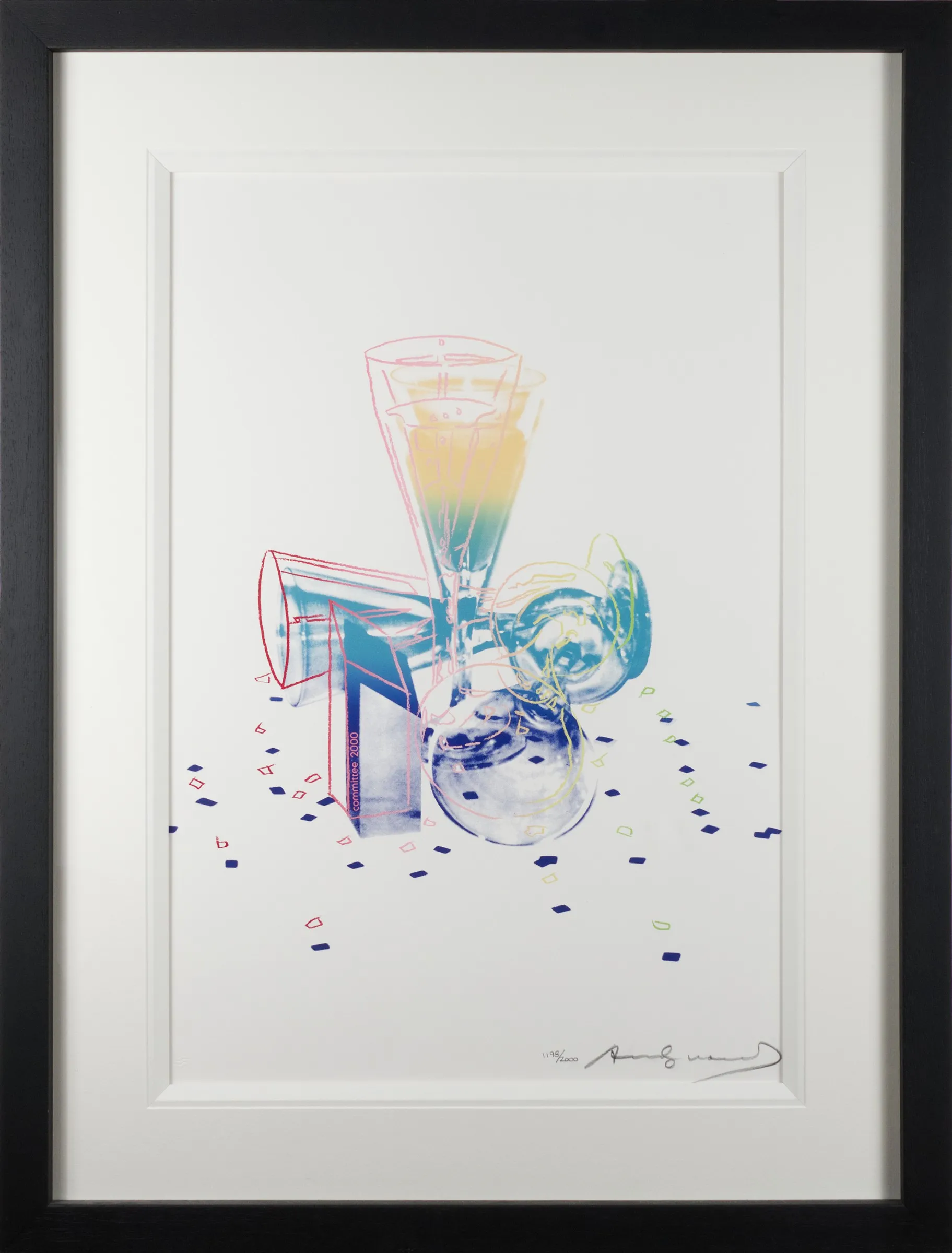
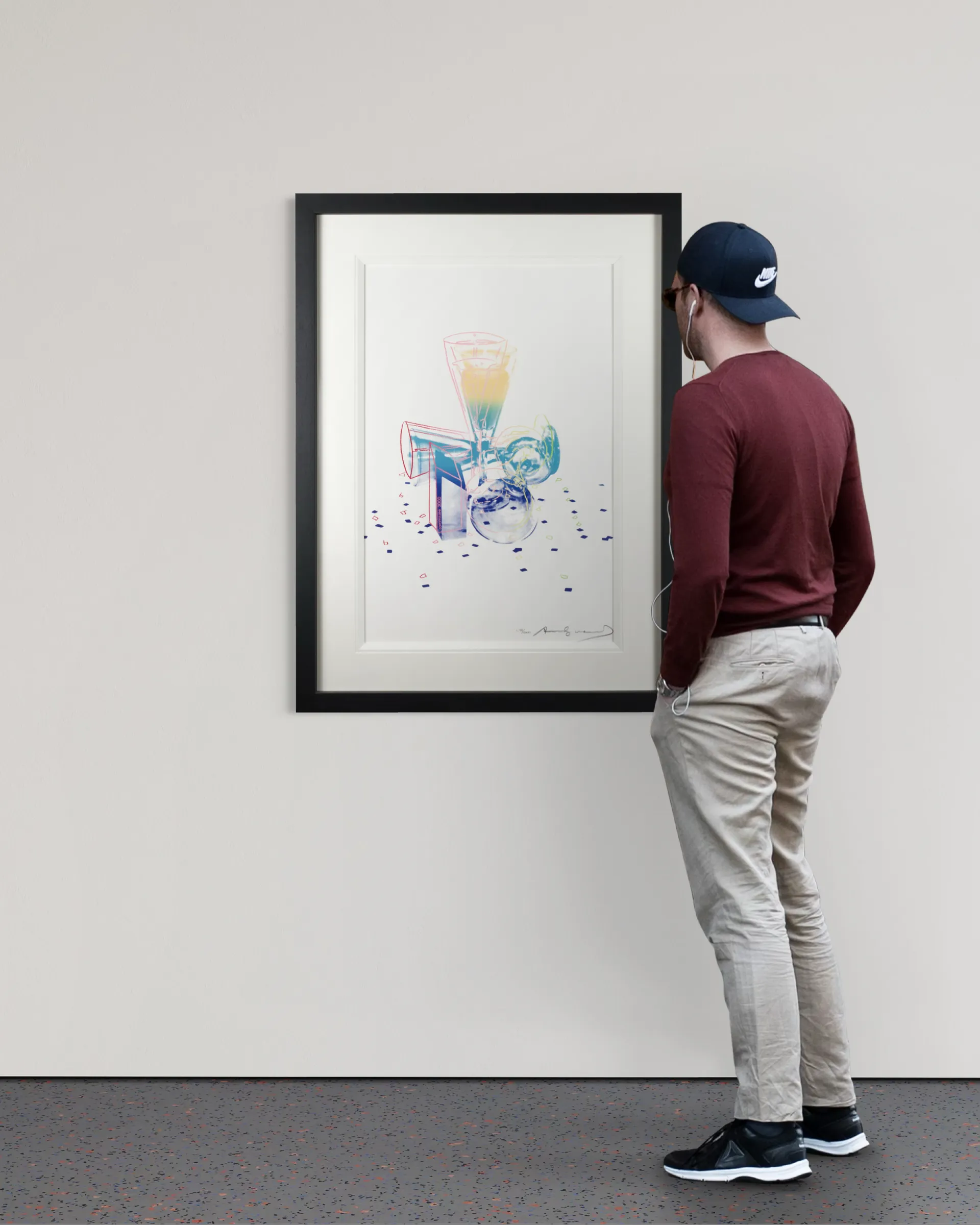
At first glance, the composition presents a group of drinking glasses arranged as a celebratory still life. Some stand upright while others appear overturned or rest at angles, surrounded by scattered pieces of confetti. The familiar imagery of a party has been reduced to translucent outlines and layered colour, giving the scene an almost weightless, spectral quality.
Unlike his celebrated portraits of Marilyn Monroe or Elizabeth Taylor, Committee 2000 is not centred upon celebrity or consumer products. Instead, it was created for an organisation whose very name looked towards the future. Warhol responded not by illustrating technological progress directly, but by distilling the optimism of the age into an image of remarkable clarity and universal appeal.
Every element within the composition has purpose. Fine outlines and translucent passages of colour give the composition definition without overwhelming the expansive white ground, while carefully balanced forms guide the eye naturally across the surface. The composition is bold and graphic without becoming static: the relationship between positive and negative space creates rhythm and movement, allowing the eye to circulate naturally around the image.
Perhaps the greatest achievement of Committee 2000 is its openness. Some collectors are drawn to its connection with Pop Art, others to its historical association with an international cultural initiative, while many simply appreciate its graphic beauty. Like all enduring works of art, the print rewards repeated viewing, revealing new relationships and subtle qualities over time.
Collector's Insight
One of the pleasures of living with an Andy Warhol is that the work rarely remains the same in the eyes of its owner. Many collectors are first attracted by Warhol's extraordinary sense of colour and design; his prints possess an immediacy that allows them to transform a room. Yet over time, appreciation often shifts from appearance to ideas, as collectors begin to notice the precision of the composition, the subtle variations created through the screenprinting process and the intelligence behind Warhol's use of repetition, colour and symbolism.
Committee 2000 possesses a quality that distinguishes it within Warhol's graphic oeuvre. Unlike editions centred upon internationally recognised celebrities, it invites a more personal relationship with the viewer. Freed from the cultural associations of Marilyn Monroe, Mao or Mick Jagger, the work becomes less about a famous individual and more about the optimism, ambition and visual confidence that characterised Warhol's mature years.
Why It Matters to Collectors
Original lifetime screenprints by Andy Warhol occupy an important position within the history of twentieth-century printmaking. Produced under the artist's supervision, individually signed and documented in the catalogue raisonné by Frayda Feldman and Jörg Schellmann, they are recognised internationally as original works of graphic art.
Committee 2000 possesses many of the qualities sought by experienced collectors. It was created during Warhol's mature period, printed by his long-standing collaborator Rupert Jasen Smith, published during the artist's lifetime and produced on Lenox Museum Board, the premium support used for many of his finest editions. This impression bears Warhol's pencil signature and Rupert Jasen Smith's embossed blind stamp, important identifying features of the edition.
Committee 2000 combines a clearly documented production history with a distinctive place in Warhol's later work. Its lifetime publication, signature, recognised printer and catalogue raisonné reference provide collectors with a strong framework for identification, while its celebratory imagery and restrained palette distinguish it visually from many of his better-known editions.
Part V, The Artist's Legacy
The Artist's Final Decade
By the early 1980s, Andy Warhol had become one of the most recognisable artists in the world. More than twenty years after helping to define the Pop Art movement, he had moved far beyond the role of artistic provocateur to become an internationally respected cultural figure. His successive New York studios, collectively known as the Factory, remained centres of artistic production and social exchange.
Far from slowing down, the final decade of Warhol's career proved remarkably productive. Alongside major painting commissions, he produced some of his most technically accomplished screenprints, including celebrated portfolios such as Myths (1981), Endangered Species (1983), Ads (1985) and Reigning Queens (1985). Created in 1982, Committee 2000 belongs to this mature period of artistic confidence, reflecting Warhol's growing engagement with international organisations and public projects beyond the traditional gallery environment.
Warhol's unexpected death in 1987, following complications after gallbladder surgery, brought one of the most influential artistic careers of the twentieth century to an abrupt end. Yet his final decade left an extraordinary legacy of paintings, prints and commissions that continue to shape our understanding of contemporary art.
Andy Warhol: The Artist
Andy Warhol (1928-1987) was one of the most influential artists of the twentieth century, whose work fundamentally transformed the relationship between fine art and popular culture. Born Andrew Warhola in Pittsburgh, Pennsylvania, to parents from present-day Slovakia, Warhol studied commercial art before moving to New York in 1949. He quickly established himself as one of America's leading commercial illustrators, producing drawings for fashion magazines, advertising agencies and major retail clients - early experience that profoundly influenced the artistic language that later defined Pop Art.
During the early 1960s, Warhol began appropriating images from everyday life, including Campbell's Soup Cans, Coca-Cola bottles, dollar bills and photographs of film stars such as Marilyn Monroe and Elizabeth Taylor. Through screenprinting and repetition, he challenged conventional ideas of originality, authorship and artistic value.
Beyond painting and printmaking, Warhol explored photography, filmmaking, publishing and television, becoming one of the first artists to operate across multiple forms of media. His New York studio, The Factory, became synonymous with artistic experimentation and cultural innovation, attracting figures from the worlds of art, music, fashion and film.
Museum Collections
One of the clearest indicators of an artist's enduring importance is the presence of their work in major public collections. Andy Warhol's work is represented in many of the world's most prestigious museums, including The Andy Warhol Museum, Pittsburgh; the Museum of Modern Art and the Whitney Museum of American Art, New York; the Metropolitan Museum of Art, New York; the Solomon R. Guggenheim Museum, New York; the National Gallery of Art, Washington, D.C.; Tate, London; the Centre Pompidou, Paris; the Art Institute of Chicago; and Museum Ludwig, Cologne.
Together, these collections demonstrate the international recognition of Warhol's work and ensure that future generations continue to study and appreciate one of the twentieth century's most influential artists.
Recognition & Legacy
During his lifetime, Warhol's use of commercial imagery, mechanical reproduction and repetition challenged prevailing assumptions about originality and artistic value. These once-controversial strategies are now understood as central to the development of post-war art.
Since his death in 1987, major retrospectives and sustained academic research have reinforced his international reputation. His paintings and prints are held in leading public collections, while lifetime editions documented in Feldman and Schellmann occupy an established position within the market for twentieth-century graphic art. Warhol's influence remains visible across contemporary art, graphic design, fashion, photography, music and digital media; the image-driven culture he examined has not disappeared, it has become more pervasive.
Part VI, Reference
Selected Literature
Frayda Feldman & Jörg Schellmann. Andy Warhol Prints: A Catalogue Raisonné 1962-1987. The definitive reference for Warhol's original prints; Committee 2000 is catalogued as FS II.289, and its inclusion confirms the edition's place within Warhol's authenticated graphic oeuvre.
Andy Warhol. The Philosophy of Andy Warhol (From A to B and Back Again). Warhol's own reflections on art, fame, business and contemporary society, providing an understanding of the artist's thinking beyond the studio.
David Bourdon. Warhol. One of the earliest comprehensive biographies, written by a close friend of the artist.
Victor Bockris. The Life and Death of Andy Warhol. A detailed biography exploring Warhol's life, artistic development and cultural influence.
Blake Gopnik. Warhol. A major recent biography drawing upon extensive archival research to reassess Warhol's life, work and enduring significance.
About Ewan Macfarlane Gallery
Ewan Macfarlane Gallery is an independent gallery specialising in Modern, Post-War and Contemporary art. The gallery believes that collecting should begin with a meaningful response to the artwork and be supported by knowledge, careful research and honest guidance. Every work is considered not only for its visual strength, but also for its authorship, condition, provenance and place within the artist's wider practice.
The Collector's Monograph Series has been created to give collectors a deeper understanding of individual artworks. Each publication brings together art history, technical explanation, close visual analysis and practical collecting knowledge, making scholarship accessible without reducing its substance.
Ewan Macfarlane has nearly twenty years' experience in the fine-art market and studied Twentieth Century Art at Sotheby's Institute of Art. The gallery offers personal guidance from first enquiry through to viewing, acquisition, framing, delivery and installation, with private appointments, home consultations and worldwide shipping available.
Closing Reflection
Conceived in 1982 for an initiative looking towards the new millennium, Committee 2000 remains both celebratory and distinctly of its period. Its glasses, confetti and translucent colour evoke a moment of anticipation, while Warhol's screenprinted treatment transforms familiar party imagery into something poised between still life, symbol and cultural document.
More than four decades later, the edition retains its immediacy. It reflects Warhol's understanding that familiar images can acquire new meaning through selection, repetition and transformation. At once accessible and elusive, Committee 2000 invites sustained looking and rewards the collector with qualities that extend well beyond its initial visual impact.