
Twentieth Century Modern Masters
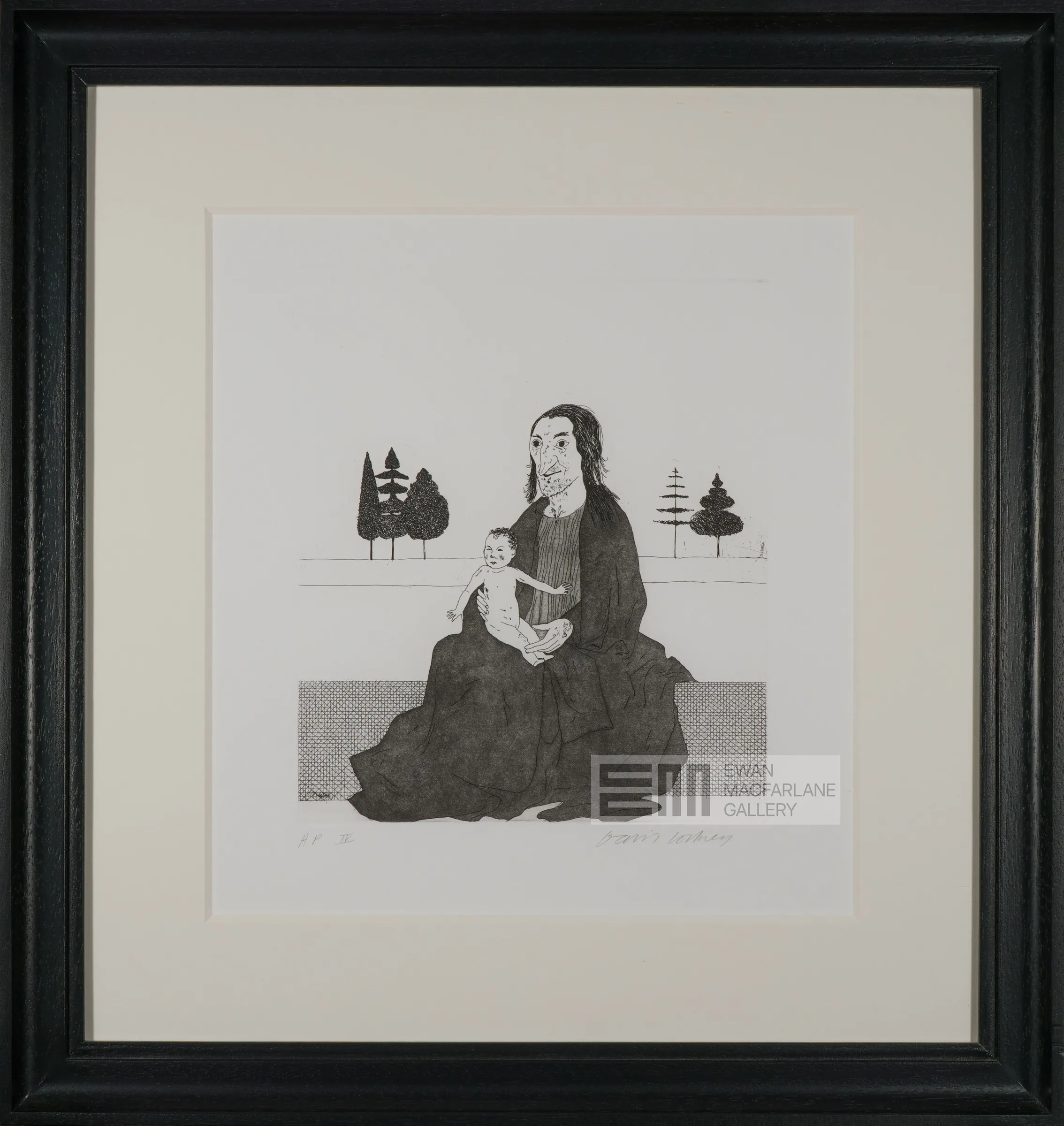
The Enchantress with the Baby Rapunzel
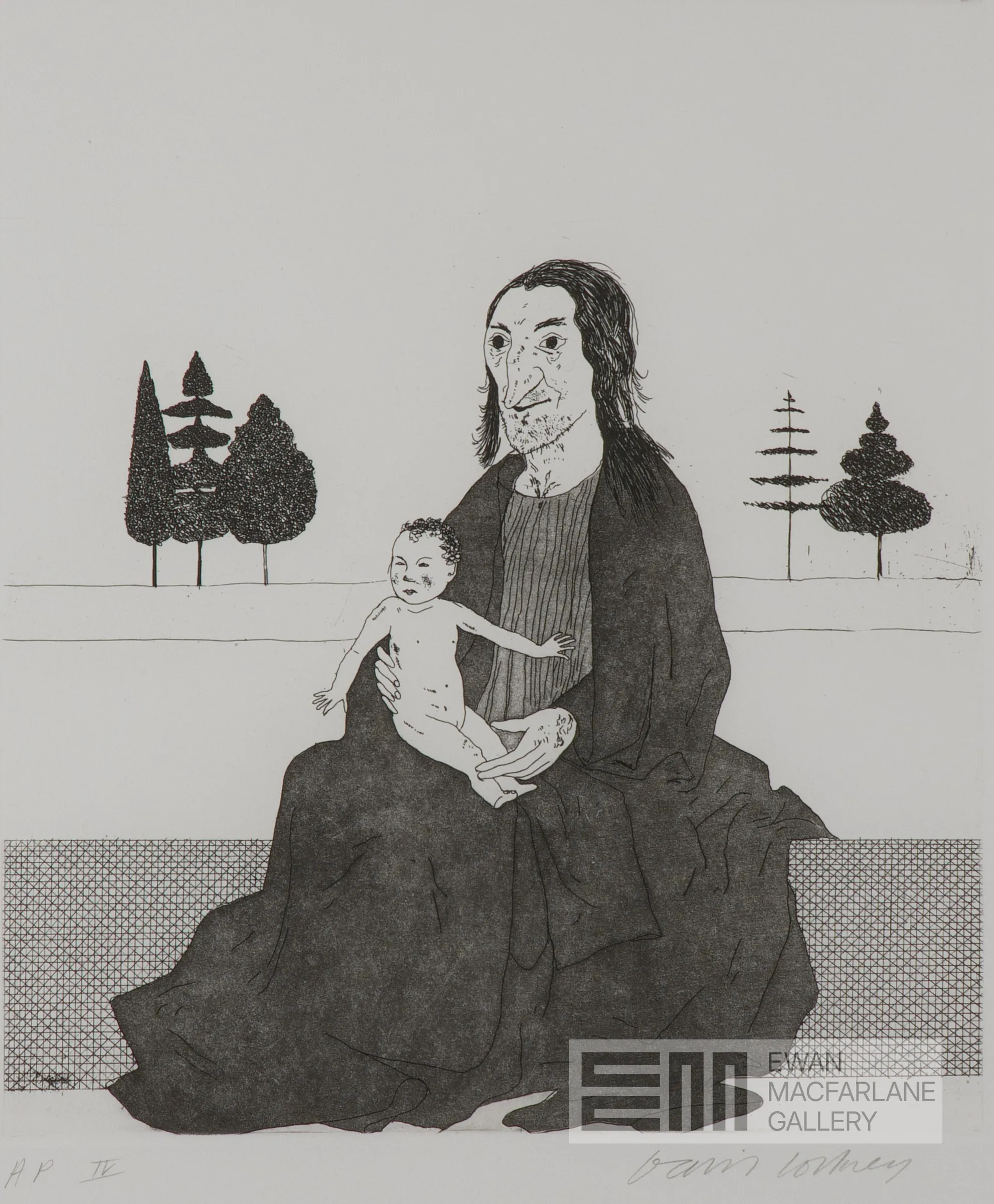
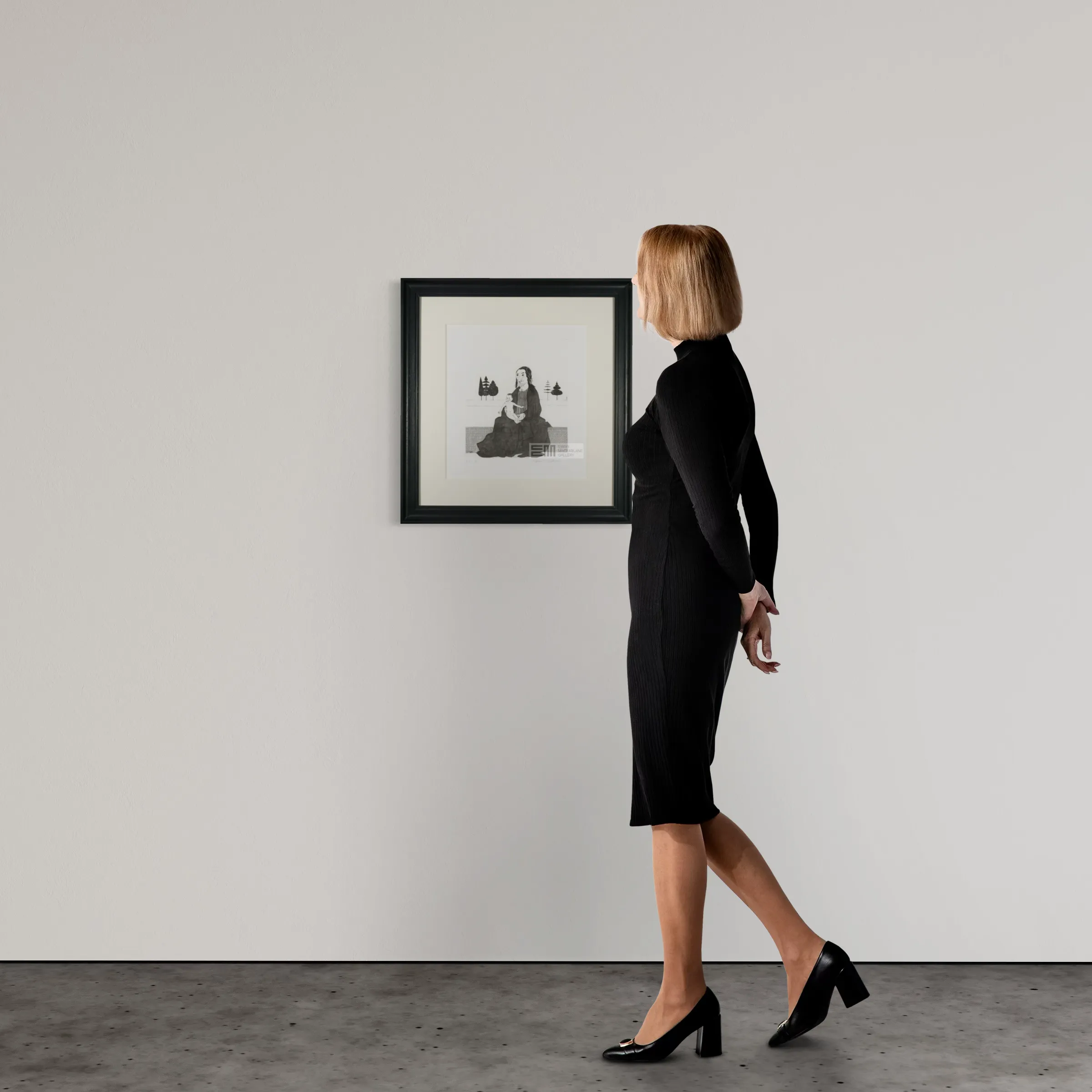
The Enchantress with the Baby Rapunzel is plate 14 from David Hockney’s Illustrations for Six Fairy Tales from the Brothers Grimm, a group of thirty-nine etchings made in 1969 and published the following year. Hockney places the darkly robed enchantress and the infant Rapunzel against an almost empty landscape of carefully spaced trees, allowing the figures’ stillness, direct gaze and unusual scale to carry the psychological weight of the scene.
The enchantress’s frontal pose and broad dark clothing give her the gravity of a devotional figure, yet the bare setting and simplified trees prevent the image from settling into conventional religious or narrative illustration. Rapunzel appears small and exposed against the adult figure, and the contrast between the child’s pale body and the enchantress’s dense robe makes possession, protection and unease coexist within the same quiet scene.
Hockney combined hard-ground etching and aquatint on a single copper plate, using etched line for the faces, hands, trees and folds of the robe while aquatint supplies the granular tonal fields that give the seated figure its dark mass. The plate measures approximately 27.3 × 23.5 cm and was printed on Hodgkinson handmade paper by Piet Clement at the Print Shop in Amsterdam, after proofs prepared with Maurice Payne in London.
In the Brothers Grimm tale, Rapunzel is surrendered to an enchantress after her father steals rampion from the woman’s garden, and is later confined in a tower reached by climbing her extraordinarily long hair. Hockney preferred the word enchantress to witch because he considered it less harsh, a choice that leaves the woman’s relationship with the child morally ambiguous rather than presenting her as a simple caricature of evil. Hockney selected six tales from the Brothers Grimm and interpreted them through thirty-nine etchings, reducing each story to sharply chosen incidents rather than illustrating every stage of the plot; he reportedly drew the enchantress’s distinctive headwear from a detail in Pieter Bruegel, while the seated mother-and-child arrangement recalls early devotional imagery associated with artists such as Hieronymus Bosch.
This impression is signed in pencil and inscribed AP IV, distinguishing it from both the standard signed edition of 100 and the larger unsigned book edition, while the DH PP watermark identifies the specially made Hodgkinson paper associated with the project. Its proof status, documented printer and publisher, and inclusion as Scottish Arts Council 83 and Tokyo 80 give the work a clear place within one of Hockney’s most important early print portfolios.
“In the end, nobody knows how it's done—how art is made. It can't be explained.”
— David Hockney
Why This Work Matters
This impression is signed in pencil and inscribed AP IV, distinguishing it from both the standard signed edition of 100 and the larger unsigned book edition. Its documented printer and publisher, watermarked handmade paper and established catalogue references as Scottish Arts Council 83 and Tokyo 80 make it an especially well-documented impression from a portfolio closely associated with Hockney's early maturity as a printmaker.
Catalogue Entry
- Artist
- David Hockney (1937–2026)
- Title
- The Enchantress with the Baby Rapunzel
- Date
- 1969
- Medium
- Hard-ground etching and aquatint from one copper plate
- Support
- Hodgkinson handmade paper; DH PP watermark
- Signature
- Signed by the artist in pencil
- Edition
- Artist's proof AP IV; signed edition of 100; unsigned book edition
- Image dimensions
- Approx. 27.3 × 23.5 cm
- Printer
- Piet Clement, the Print Shop, Amsterdam
- Publisher
- Petersburg Press with Kasmin Gallery, London
- Literature
- Scottish Arts Council 83; Tokyo 80
- Reference
- 422
£3,850
Available
Unframed sheet