
David Hockney
David Hockney was one of Britain’s most influential and recognisable artists, celebrated for his vivid colour, distinctive draughtsmanship and enduring curiosity about how we see. His work brought a fresh perspective to familiar subjects, from portraits of friends and sunlit swimming pools to the changing landscapes of Yorkshire and Normandy.
Born in Bradford in 1937, Hockney emerged alongside the rise of British Pop Art, while developing an independent approach rooted in observation and experimentation. The clarity of his Californian paintings, the intimacy of his portraits and the inventive spaces of his landscapes reveal an artist continually reconsidering the possibilities of representation.
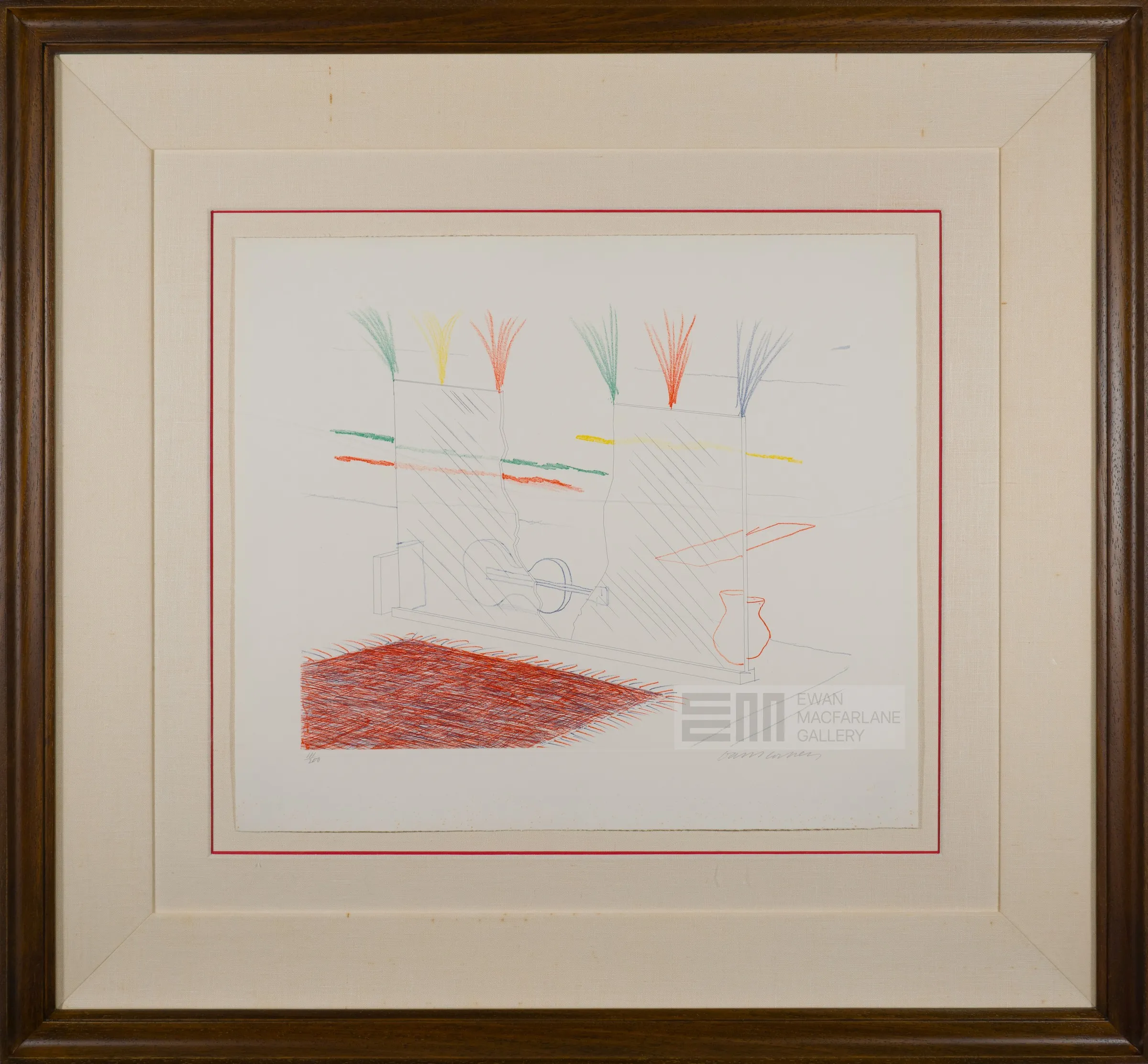
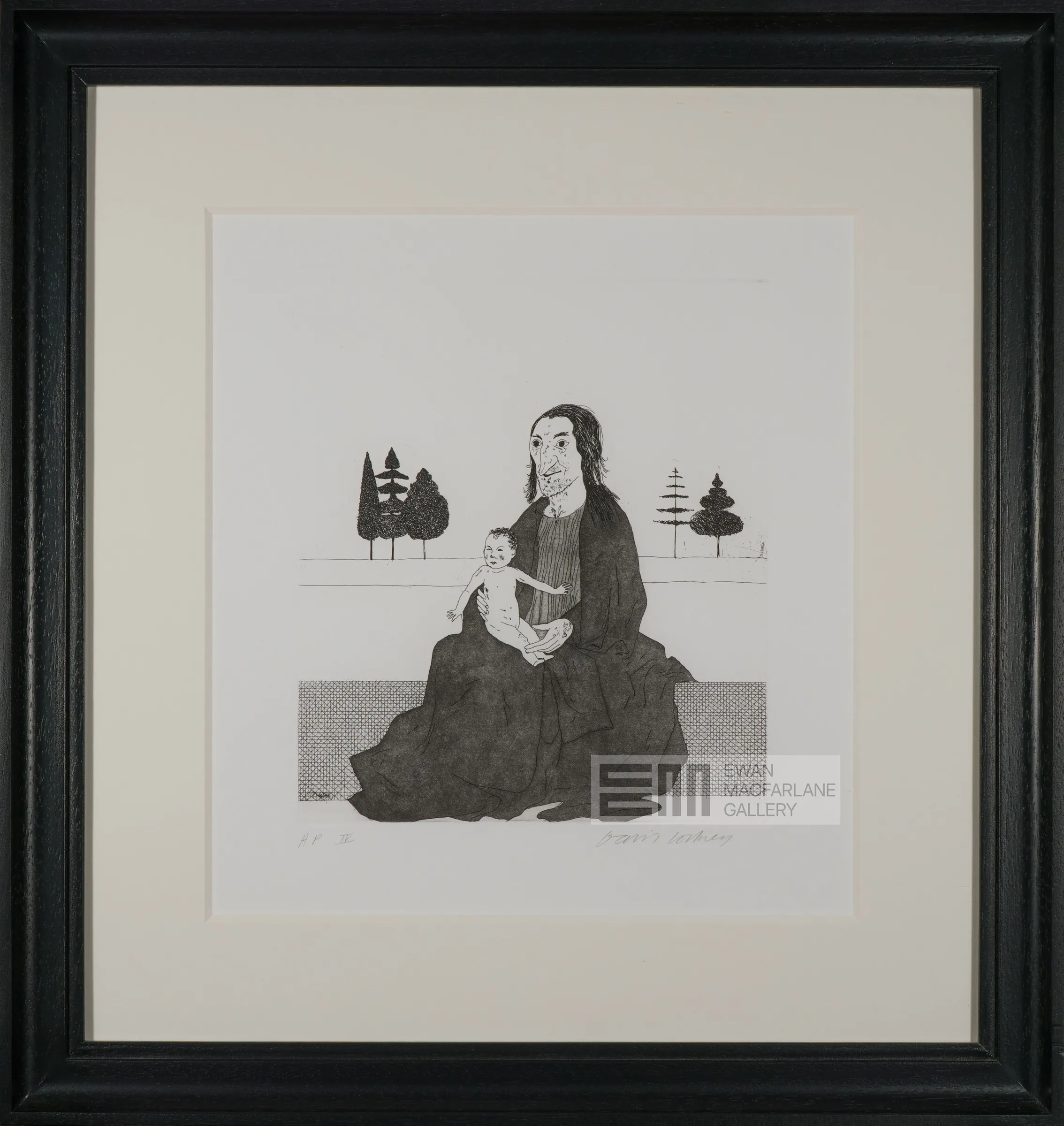
Alongside painting and drawing, Hockney explored etching, lithography, photographic collage and digital image-making. Whether working with a printing plate, a camera or an iPad, he approached each medium with imagination and purpose. His art invites us to look more closely, finding complexity, pleasure and surprise in the everyday world.
Available Artworks
David Hockney: Life and Work
Early Life and Artistic Development
Born in Bradford, Yorkshire, in 1937, David Hockney developed an early commitment to drawing. He studied at Bradford School of Art before attending the Royal College of Art in London from 1959 to 1962.
His student work brought together expressive figures, handwritten words and references to popular culture. Personal experience, literature and his identity as a gay man informed paintings that were playful, candid and formally adventurous.
Although associated with the emergence of British Pop Art, Hockney pursued an independent course. His fascination with the history of painting was accompanied by a willingness to question its conventions.
California and the Swimming Pool
California became a defining source of inspiration during the 1960s. Its intense light, modern architecture and outdoor life offered Hockney a striking contrast to the surroundings of his childhood.
Swimming pools provided a particularly rich subject. Their geometric edges could organise a composition, while reflections and moving water presented the challenge of depicting something constantly changing.
In A Bigger Splash (1967), a sudden disturbance interrupts an otherwise still scene. The contrast between the carefully ordered setting and the fleeting movement of water exemplifies Hockney’s ability to make an apparently simple image reward sustained attention.
Portraiture and Personal Relationships
Portraiture remained central to Hockney’s work. Friends, family and partners became recurring subjects, giving his pictures an intimacy grounded in familiarity and prolonged observation.
His double portraits explore relationships through posture, placement and the spaces between figures. Furniture, windows and objects help establish the emotional atmosphere, allowing domestic interiors to become settings for subtle human narratives.
Drawing offered a more immediate way to record those around him. An economical line could suggest a sitter’s character through a tilted head, a resting hand or a particular way of occupying a chair.
Printmaking and Visual Storytelling
Hockney’s prints form a substantial part of his artistic achievement. Etching and lithography offered different possibilities for line, texture, colour and narrative, which he explored with the same curiosity he brought to painting.
His early etching series A Rake’s Progress (1961–63) reinterpreted William Hogarth’s subject through experiences associated with his first visit to New York. Later projects, including his illustrations for the fairy tales of the Brothers Grimm, demonstrate the expressive range of his graphic work.
Across these prints, spare passages of drawing can sit beside densely worked surfaces. The medium becomes an active part of the storytelling, shaping how figures, interiors and imagined events unfold.
Photography and Ways of Seeing
Hockney’s photographic collages, often called “joiners”, challenged the idea that a single photograph could adequately describe our experience of looking.
Combining individual photographs taken from different positions and at different moments, he constructed images that suggest movement through a scene. A subject emerges through multiple viewpoints rather than one fixed perspective.
These experiments connect with a broader concern running through his work: how to represent space, time and the activity of seeing on a flat surface.
Landscape, Digital Experimentation and Renewed Recognition
In his later landscapes, Hockney returned repeatedly to the roads, trees and fields of Yorkshire, finding variety in places transformed by weather and seasonal change. Large paintings assembled from multiple canvases gave these familiar surroundings an expansive, immersive presence.
This work brought renewed public attention to his practice. The Royal Academy’s landmark exhibition David Hockney: A Bigger Picture (2012) placed landscape at the centre of his achievement, presenting ambitious paintings alongside his experiments with iPad drawing and film.
His adoption of digital tools extended a lifelong interest in new ways of making pictures. The iPhone and iPad allowed him to record colour, light and seasonal changes with immediacy, while Normandy subsequently provided another rich setting for observation.
The major retrospective that opened at Tate Britain in 2017, before travelling to the Centre Pompidou in Paris and the Metropolitan Museum of Art in New York, placed these later developments within the wider story of his career. These exhibitions demonstrated the continuing vitality of an artist whose curiosity crossed generations and media.
Museums, Exhibitions and Legacy
Hockney’s career received sustained international recognition, culminating in the extensive survey David Hockney 25 at the Fondation Louis Vuitton in Paris in 2025. Bringing together work spanning seven decades, the exhibition reflected the range of his artistic investigations.
The David Hockney Foundation preserves an extensive collection encompassing paintings, drawings, editioned prints, photographic works and digital projects. Its holdings provide a lasting resource for understanding the connections across his varied practice.
Hockney died in June 2026. Across traditional and emerging media, his enduring contribution was to encourage a more attentive way of seeing, finding visual richness in familiar places, personal relationships and the changing natural world.
Enquiries
For more information about David Hockney’s work and available artworks, please contact the gallery.