
Roy Lichtenstein
Roy Lichtenstein was one of the defining figures of American Pop Art, celebrated for transforming the imagery of comic books, advertising and popular culture into striking paintings and prints. His bold outlines, vivid colours and characteristic dots created an instantly recognisable visual language that challenged distinctions between commercial imagery and fine art.
Born in New York in 1923, Lichtenstein developed his mature style in the early 1960s. Enlarging and reworking familiar images, he explored how emotion, action and everyday experience could be communicated through established visual conventions.
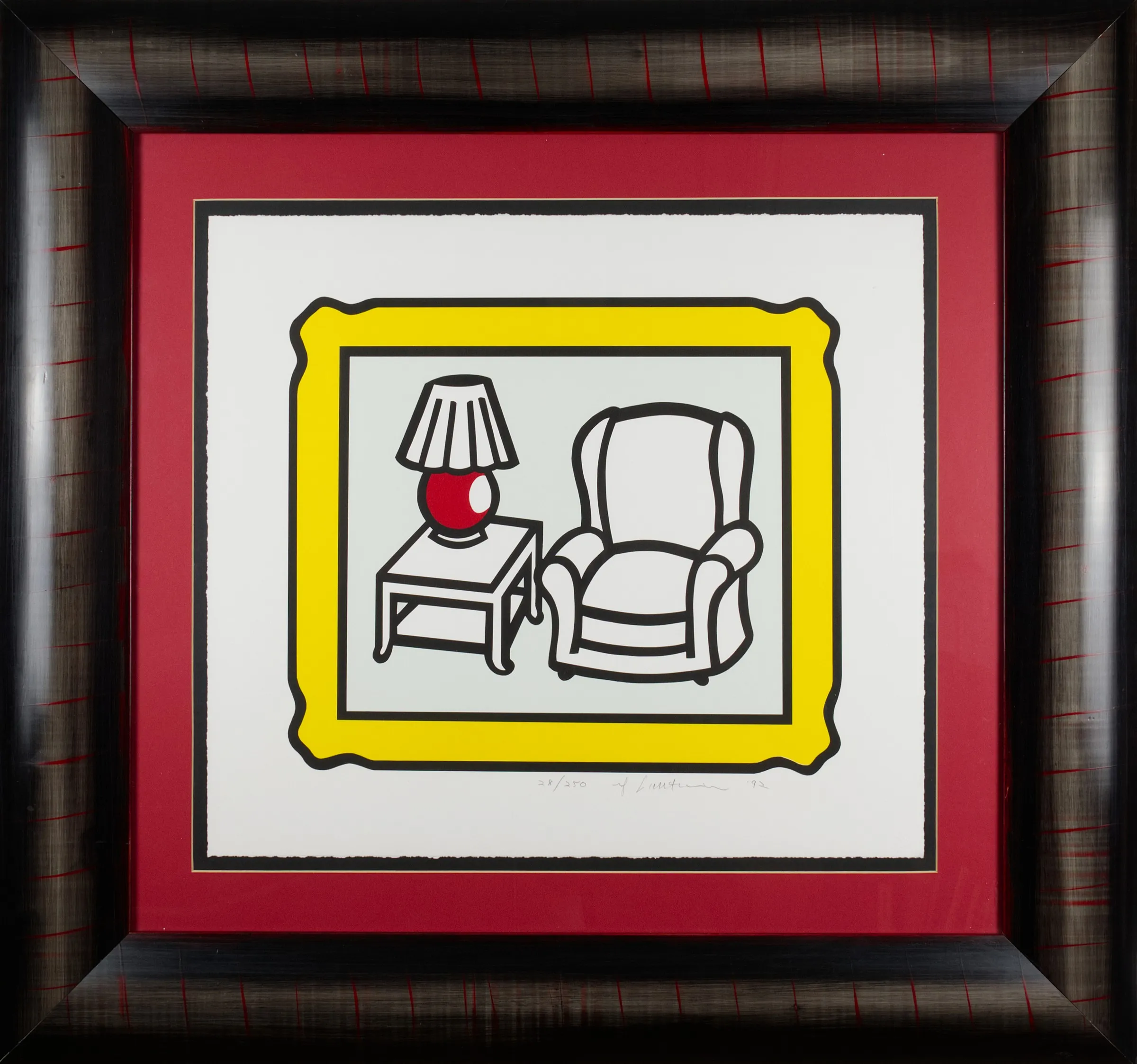
Beyond his celebrated comic-inspired paintings, his subjects encompassed landscapes, still lifes, interiors and reinterpretations of modern masters. Printmaking became an important setting for technical experimentation, allowing him to investigate colour, pattern, texture and reflection. Combining visual clarity with wit and careful construction, Lichtenstein’s work invites us to reconsider the images we recognise and the ways they shape our perception of the world around us.
Available Artworks
Roy Lichtenstein: Life and Work
Early Life and Artistic Development
Born in New York City in 1923, Roy Lichtenstein developed an early interest in drawing, painting and music. Visits to museums introduced him to artists whose work would remain important throughout his career, including Rembrandt and Picasso.
He studied at Ohio State University, where the teaching of Hoyt L. Sherman encouraged close attention to perception and the organisation of a composition. His education was interrupted by military service during the Second World War, after which he returned to complete his studies.
Before achieving recognition, Lichtenstein combined teaching with an evolving artistic practice. His early experiments provided the foundation for a sustained investigation into how images are constructed and understood.
Pop Art and the Comic Image
In the early 1960s, Lichtenstein began making paintings based on comic books and advertisements. Enlarged figures, speech balloons and simplified settings brought imagery associated with inexpensive printed material into the space of fine art.
Works such as Drowning Girl and Whaam!, both painted in 1963, became landmarks of this approach. Romance and combat supplied dramatic subjects, while their presentation revealed the conventions through which popular imagery communicates emotion and action.
Lichtenstein cropped, redrew and rearranged his sources, carefully adjusting their compositions. His use of existing illustrations also raised questions about authorship, originality and the different values assigned to commercial and gallery art, questions that remain part of the discussion surrounding his work.
Dots, Colour and Visual Language
Lichtenstein’s characteristic dots refer to commercial printing techniques used to produce tones and colours economically. Enlarged within his paintings, they become conspicuous elements of the image rather than disappearing into its surface.
Thick black contours, diagonal lines and flat areas of colour contribute to the same effect. Together, they give his work an apparently impersonal finish, even when the subject involves intense feeling.
This tension is central to his art. A tear, an embrace or an explosion appears immediate and dramatic, yet is visibly assembled from a controlled vocabulary of marks. The viewer encounters both the subject and the visual machinery used to describe it.
Printmaking and Technical Experimentation
Printmaking offered Lichtenstein a particularly rich setting for exploring the relationship between an image and its production. He worked across processes including screenprinting, lithography, woodcut and intaglio, often combining techniques and materials.
His Ten Landscapes portfolio of 1967 extended the familiar subjects of sky, land and water through synthetic surfaces, printed patterns and collage. Reflective materials introduced shifting effects that changed with the light and the viewer’s position.
These experiments demonstrate the breadth of his graphic practice. Prints became opportunities to test how texture, colour and manufactured materials could alter the experience of an image.
Art History, Brushstrokes and Reflection
Lichtenstein’s attention extended beyond popular culture to the established languages of art. He reworked subjects and styles associated with artists including Picasso, Mondrian and Cézanne, translating their approaches into his own vocabulary.
His Brushstrokes works turned the expressive painterly gesture into a carefully outlined motif. A mark associated with spontaneity became something planned, repeatable and recognisable.
Other series explored mirrors, reflections and artists’ studios. These subjects allowed him to examine how a flat surface can suggest another space, or how a few conventional marks can make us recognise something that is not physically present.
Later Work and Expanding Subjects
Throughout his later career, Lichtenstein continued to revisit familiar genres through new compositions. Interiors, nudes and landscapes offered fresh possibilities for combining pattern, spatial ambiguity and visual quotation.
His landscapes inspired by Chinese painting brought his dotted surfaces into conversation with mountains, mist and water. The meeting of these different pictorial traditions produced images that are both spacious and visibly constructed.
Sculpture and large-scale works extended related concerns into three dimensions. Across these varied forms, his central interest remained the relationship between what we see and the conventions that make it recognisable.
Museum Collections, Exhibitions and Legacy
Lichtenstein’s work is held in major public collections internationally. Tate holds Whaam! (1963), while the Museum of Modern Art in New York holds Drowning Girl (1963). The Metropolitan Museum of Art also holds examples of his experimental printmaking.
The major retrospective that opened at the Art Institute of Chicago in 2012, before travelling to the National Gallery of Art in Washington and Tate Modern in London, demonstrated the range of his achievement beyond the early comic paintings.
Lichtenstein died in New York in 1997. His legacy lies in a sustained examination of how images acquire meaning through style, repetition and context. With humour and formal precision, he changed the relationship between popular imagery and modern art, encouraging viewers to look again at pictures that might otherwise seem immediately familiar.
Enquiries
For more information about Roy Lichtenstein’s work and available artworks, please contact the gallery.