
Pablo Picasso
Pablo Picasso was one of the most influential artists of the twentieth century, whose restless invention transformed the possibilities of modern art. Across painting, drawing, sculpture, printmaking and ceramics, he continually found new ways to describe the human figure, everyday objects and the world around him.
Born in Málaga in 1881, Picasso developed exceptional drawing skills before establishing his career in Paris. From the emotional intensity of his Blue Period to the development of Cubism with Georges Braque, his work challenged established ideas about representation, perspective and artistic expression.
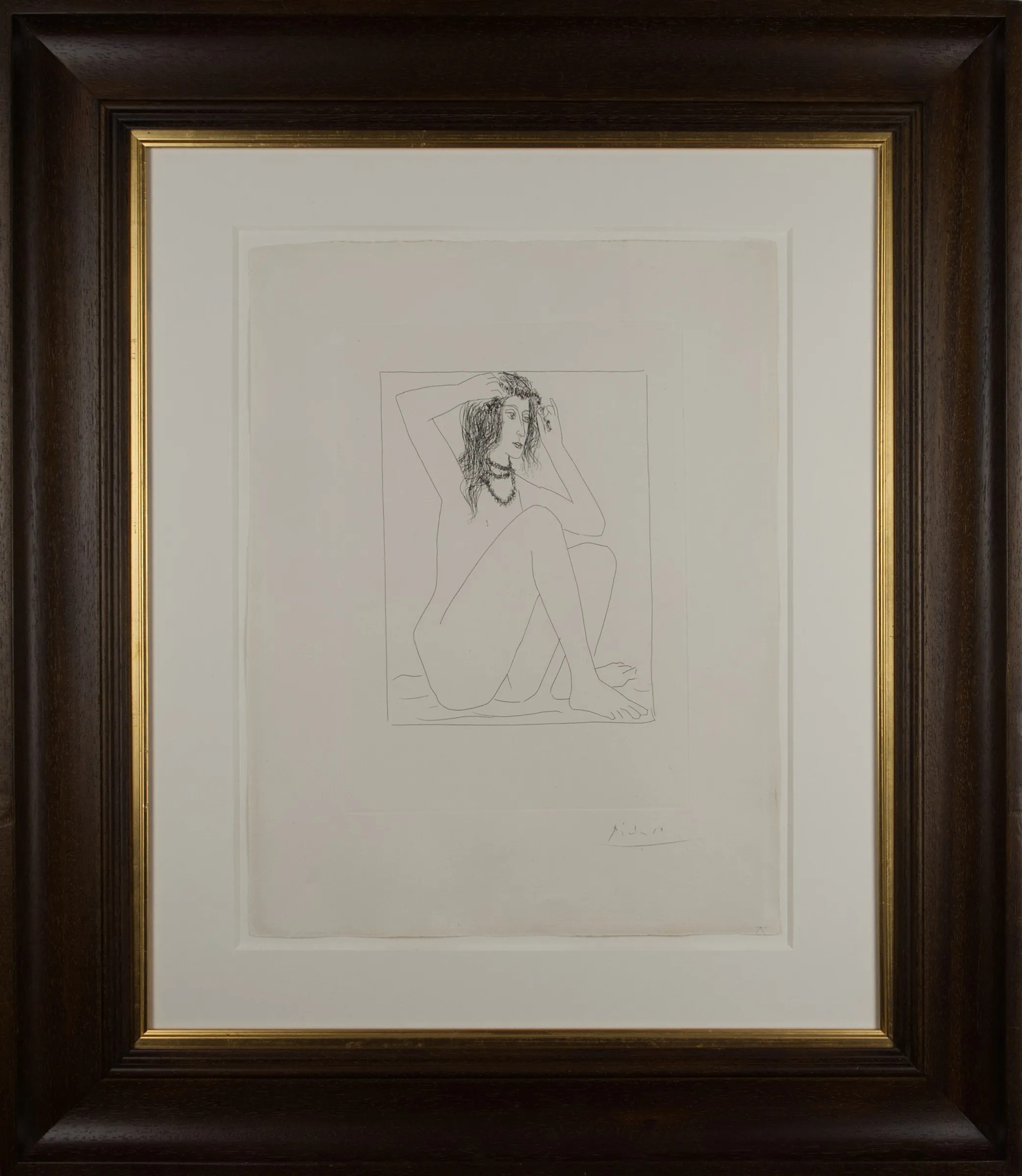
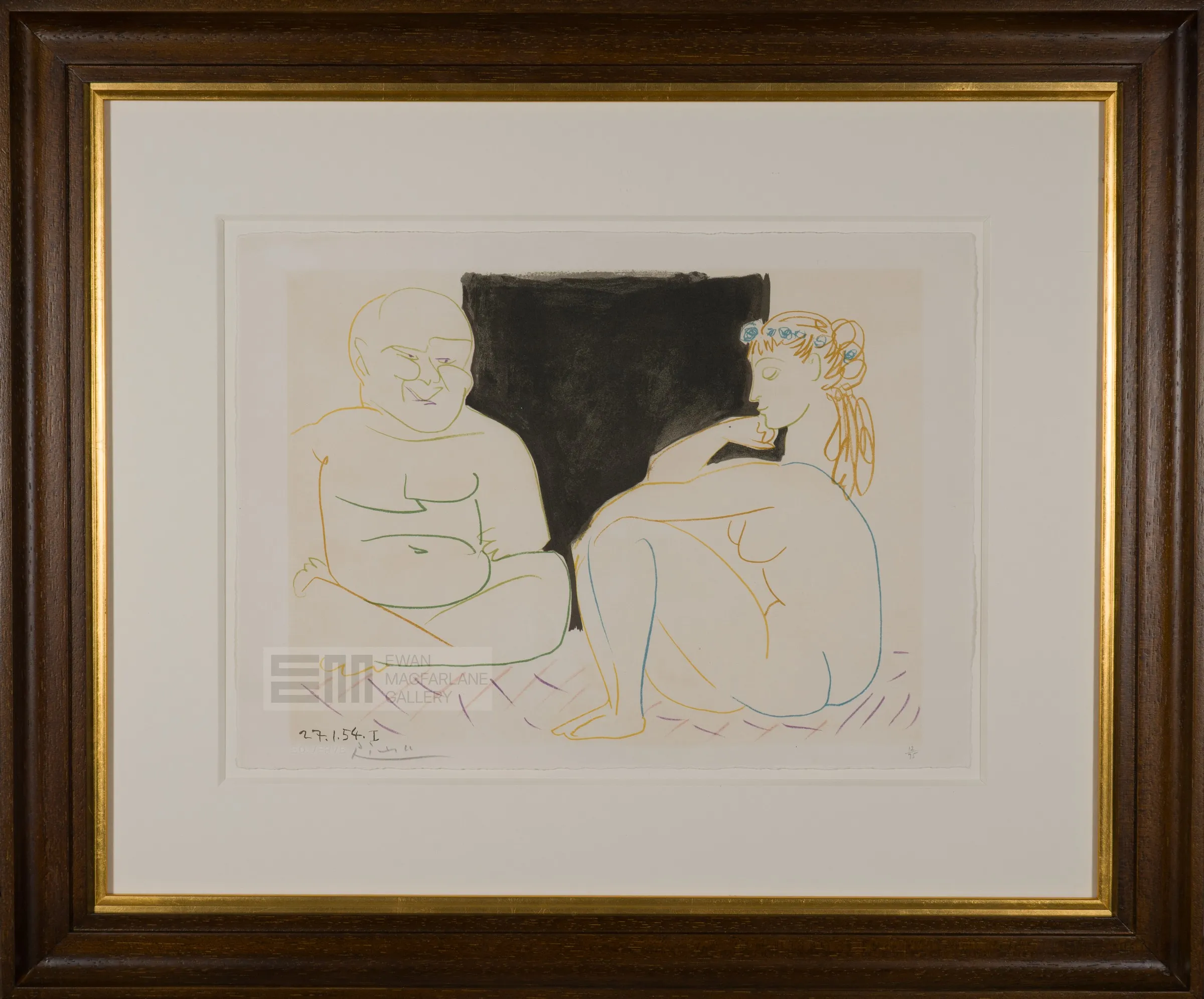
Printmaking became a central part of his practice, offering opportunities to explore intimate portraits, classical mythology, the artist’s studio and the relationship between artist and model. His etchings, lithographs and linocuts reveal both remarkable technical curiosity and an expressive command of line. Throughout his long career, Picasso combined an engagement with artistic tradition with a determination to reinvent its visual language.
Pablo Picasso: Life and Work
Early Life and Artistic Development
Born in Málaga, Spain, in 1881, Pablo Picasso showed an exceptional aptitude for drawing from childhood. His father, an artist and teacher, provided his earliest instruction, and Picasso continued his training in Barcelona and Madrid.
Barcelona’s artistic community played an important role in his development. Encounters with contemporary European art encouraged him to look beyond academic conventions, while his early visits to Paris brought him into contact with a rapidly changing cultural world.
His command of traditional drawing became the foundation for a career defined by experimentation. Even in his most radically transformed figures, an assured understanding of form remained evident.
The Blue and Rose Periods
During his Blue Period, from approximately 1901 to 1904, Picasso used a restrained palette to explore poverty, loneliness and human vulnerability. Elongated figures and spare settings gave these paintings an atmosphere of emotional isolation.
Warmer colours emerged in the subsequent Rose Period, alongside recurring images of acrobats, harlequins and travelling performers. These subjects offered opportunities to consider identity, companionship and the position of the artist within society.
Together, these early periods established concerns that would recur throughout his work: the expressive possibilities of the figure and the relationship between outward appearance and inner experience.
Cubism and a New Pictorial Language
Picasso’s Les Demoiselles d’Avignon (1907) marked a decisive challenge to conventional representations of the body and pictorial space. Its fractured forms drew on multiple sources, including Iberian sculpture and African art.
Working closely with Georges Braque, Picasso subsequently developed Cubism. Objects and figures were broken into interlocking planes, bringing different aspects of a subject together within a single image.
Their experiments also introduced everyday materials and printed matter into works of collage. Newspaper fragments and other familiar elements became active parts of the composition, changing the relationship between art and the material world.
Cubism’s influence extended far beyond painting, helping reshape sculpture, design and the visual language of the twentieth century.
Printmaking and the Artist’s Studio
Printmaking provided Picasso with a space for sustained exploration. He worked across etching, drypoint, aquatint, lithography and linocut, responding to the distinctive possibilities of each process.
The Vollard Suite, a group of 100 etchings made between 1930 and 1937, brings together recurring subjects including the sculptor’s studio, classical figures, the Minotaur and the relationship between artist and model.
Across these images, lucid outlines can give way to densely worked passages of light and shadow. Mythology and studio life become intertwined, allowing the act of artistic creation itself to become a subject.
His prints reveal a particular intimacy of thought and handling. Changes of line, texture and composition make the process of invention visible, offering a close encounter with his working imagination.
Portraiture, Mythology and Human Experience
Picasso repeatedly returned to portraiture, transforming the appearance of his subjects through shifting styles and expressive distortions. A face might be described through a few economical lines or reconstructed through contrasting viewpoints and emphatic colour.
Classical mythology provided another enduring source of imagery. The Minotaur, in particular, became a complex presence in his work, capable of suggesting strength, vulnerability and conflict.
Alongside these personal and symbolic subjects, Picasso responded to the political violence of his time. Painted in 1937 during the Spanish Civil War, Guernica transformed the suffering of civilians into a monumental image of anguish. Its fractured bodies and compressed space demonstrate how his formal inventions could carry an urgent public meaning.
Ceramics and Later Experimentation
After the Second World War, Picasso’s involvement with the Madoura pottery workshop in Vallauris opened another field of experimentation. Plates, bowls and vessels became surfaces and structures through which he explored faces, animals and Mediterranean imagery.
He treated ceramics as an opportunity to work with volume, texture and the transformation of familiar forms. The shape of a vessel could suggest a body, while painted marks could turn an everyday object into an expressive character.
His later paintings and prints also revisited earlier artists and established subjects. These reinterpretations reflected a continuing dialogue with art history, approached through increasingly direct and energetic handling.
Museum Collections and Legacy
Picasso’s work is held in major museums internationally. The Musée national Picasso-Paris preserves an extensive collection spanning painting, sculpture, drawing and printmaking, together with archives that illuminate his creative process.
The Museu Picasso in Barcelona, opened in 1963, provides an important setting for understanding his early development and his relationship with the city. Individual landmarks are also central to international collections, including Les Demoiselles d’Avignon at the Museum of Modern Art in New York and Guernica at the Museo Reina Sofía in Madrid.
Picasso died in Mougins, France, in 1973. His legacy encompasses both the innovations that helped define modernism and an extraordinary range of individual works. Across media, his enduring achievement was to make representation an open field of possibility, continually reconsidering what an image could express.
Enquiries
For more information about Pablo Picasso’s work and available artworks, please contact the gallery.