
Henry Moore
Henry Moore was one of the most influential sculptors of the twentieth century, celebrated for transforming the human figure into a language of organic shapes, flowing contours and open spaces. His reclining figures and mother-and-child compositions explore relationships between the body, the landscape and the natural world.
Born in Castleford, Yorkshire, in 1898, Moore developed an approach that combined close observation with imaginative abstraction. Bones, stones and shells offered starting points for forms that could suggest both a human presence and the contours of hills, caves or weathered rock.
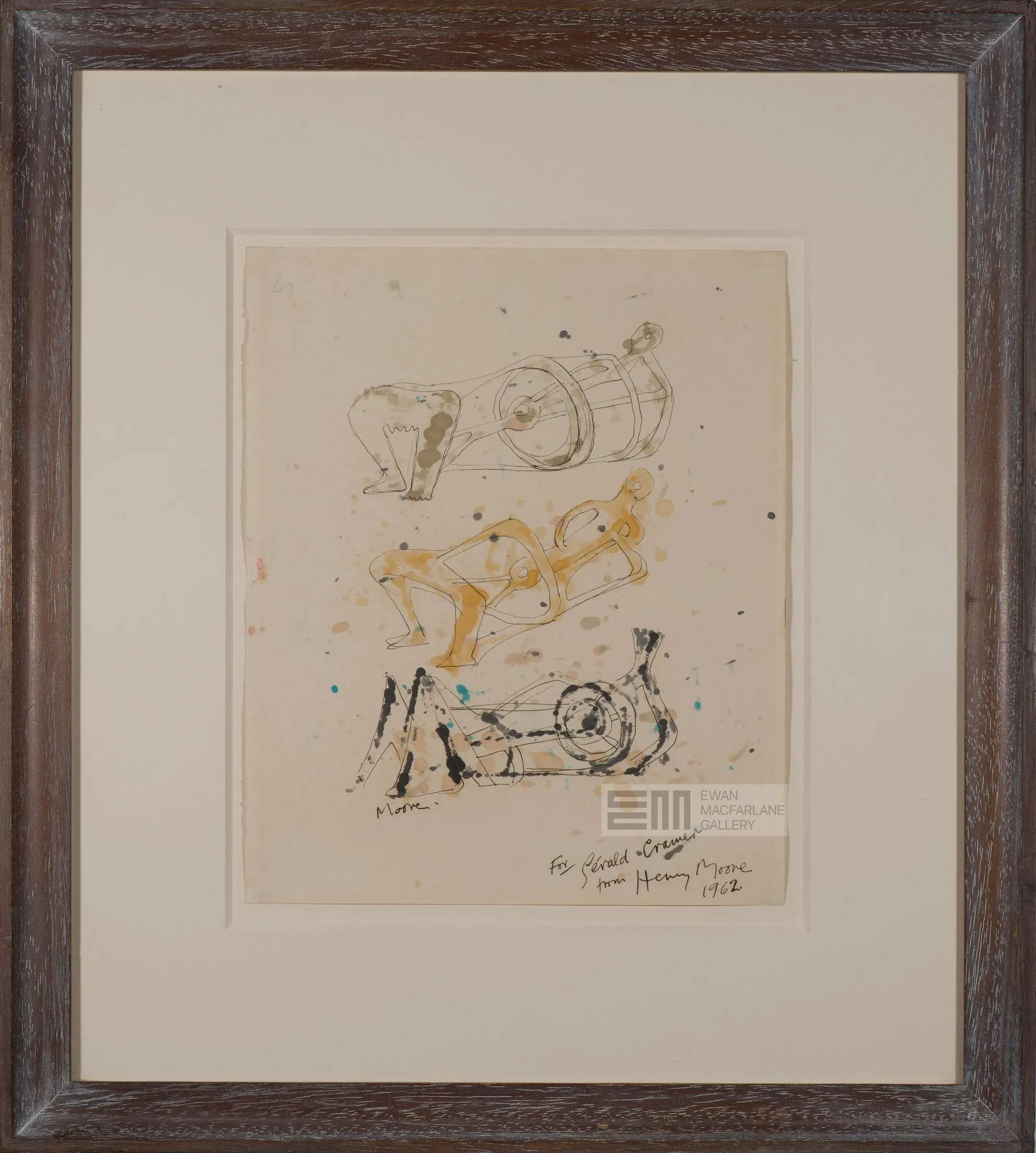
Drawing remained central throughout his career, providing a space for invention alongside his sculpture. His wartime Shelter Drawings revealed a profound sensitivity to shared human experience, while his later prints explored figures, animals and natural structures. Across intimate works on paper and monumental sculpture, Moore brought together physical strength, vulnerability and an enduring fascination with the forms and rhythms of life.
Available Artworks
Henry Moore: Life and Work
Early Life and Artistic Development
Born in Castleford, Yorkshire, in 1898, Henry Moore grew up in a mining community and developed an early ambition to become a sculptor. After training as a teacher and serving in the First World War, he entered Leeds School of Art in 1919.
A scholarship took him to the Royal College of Art in London in 1921. His studies and encounters with sculpture from different cultures encouraged him to look beyond conventional academic approaches to the figure.
In his early carvings, Moore sought to preserve the character of wood and stone. The material’s grain, weight and resistance became active elements in the development of a sculpture.
The Human Figure and Natural Forms
The human body remained the principal starting point for Moore’s sculpture, even when his forms approached abstraction. Reclining figures, seated figures and mother-and-child groups became recurring subjects through which he explored balance, protection and physical presence.
Natural objects provided a parallel source of inspiration. He collected bones, flints, shells and pebbles, studying the ways their surfaces enclosed space or revealed structures within.
These observations encouraged connections between anatomy and landscape. A shoulder might suggest a hillside, while a hollow could evoke both a bodily cavity and an opening in rock. Moore’s sculptures allow these associations to coexist without resolving into a single interpretation.
Space, Materials and Sculpture in the Landscape
Moore made the spaces within and around a sculpture as important as its solid mass. Openings allowed light to pass through the figure, changing its appearance as viewers moved around it.
His divided and interlocking forms extended this exploration. Separate elements could suggest a complete body while creating relationships across the intervening space.
As his practice developed, bronze offered opportunities to enlarge forms first explored in small models. Outdoor settings gave these works another dimension: changing light, weather and distant views became part of the encounter between sculpture and spectator.
Drawing and the Shelter Drawings
Drawing was an independent and essential part of Moore’s artistic life. It allowed him to test ideas, imagine sculptural possibilities and explore subjects beyond the practical demands of carving or casting.
During the Second World War, his drawings of people sheltering in London Underground stations brought his work to a wider public. Rows of reclining bodies, enclosed spaces and heavy drapery conveyed both individual vulnerability and collective endurance.
The Shelter Drawings transformed a contemporary experience into images with a monumental presence. Their figures suggest exhaustion and apprehension, but also the reassurance of people gathered together.
Printmaking and Works on Paper
Moore’s graphic work developed alongside his drawing and sculpture, becoming especially important during the later decades of his career. Etching and lithography offered different ways to investigate line, texture, light and volume.
His prints revisit subjects that occupied him across media, including reclining figures, mothers and children, animals and natural structures. Other projects brought his imagery into conversation with poetry and literature.
The Elephant Skull etchings demonstrate his capacity to discover an imagined world within a closely observed object. Cavities, ridges and internal structures become spaces that can suggest architecture or landscape.
Works on paper reveal the intimacy and range of Moore’s imagination. Some anticipate sculpture, while others develop their own atmosphere through colour, layered marks and the relationship between figures and their surroundings.
International Recognition and Public Sculpture
Moore’s international reputation grew substantially after the Second World War. A major retrospective at the Museum of Modern Art in New York in 1946 introduced his achievement to a wider American audience.
In 1948, he represented Britain at the Venice Biennale and received the International Sculpture Prize. Increasing opportunities for public commissions allowed him to explore the relationship between sculpture, architecture and shared space.
His work became a significant presence in the post-war landscape, bringing modern sculpture into civic settings, gardens and places of education. These commissions extended his interest in how a figure or group could establish a meaningful relationship with its surroundings.
Museum Collections, Foundation and Legacy
Moore’s work is held in major public collections internationally, including Tate in London and the Museum of Modern Art in New York. These holdings encompass sculpture and works on paper, reflecting the connections across his practice.
In 1977, Moore and his family established the Henry Moore Foundation to encourage the appreciation of sculpture. His former home and studios at Perry Green in Hertfordshire preserve an important record of his working life, with sculptures displayed in the landscape where many were developed.
Moore died at Perry Green in 1986. His enduring achievement lies in the expressive possibilities he found between the human body and natural form. Across sculpture, drawing and printmaking, he created a language capable of conveying shelter, tension, tenderness and strength.
Enquiries
For more information about Henry Moore’s work and available artworks, please contact the gallery.