
Francis Bacon
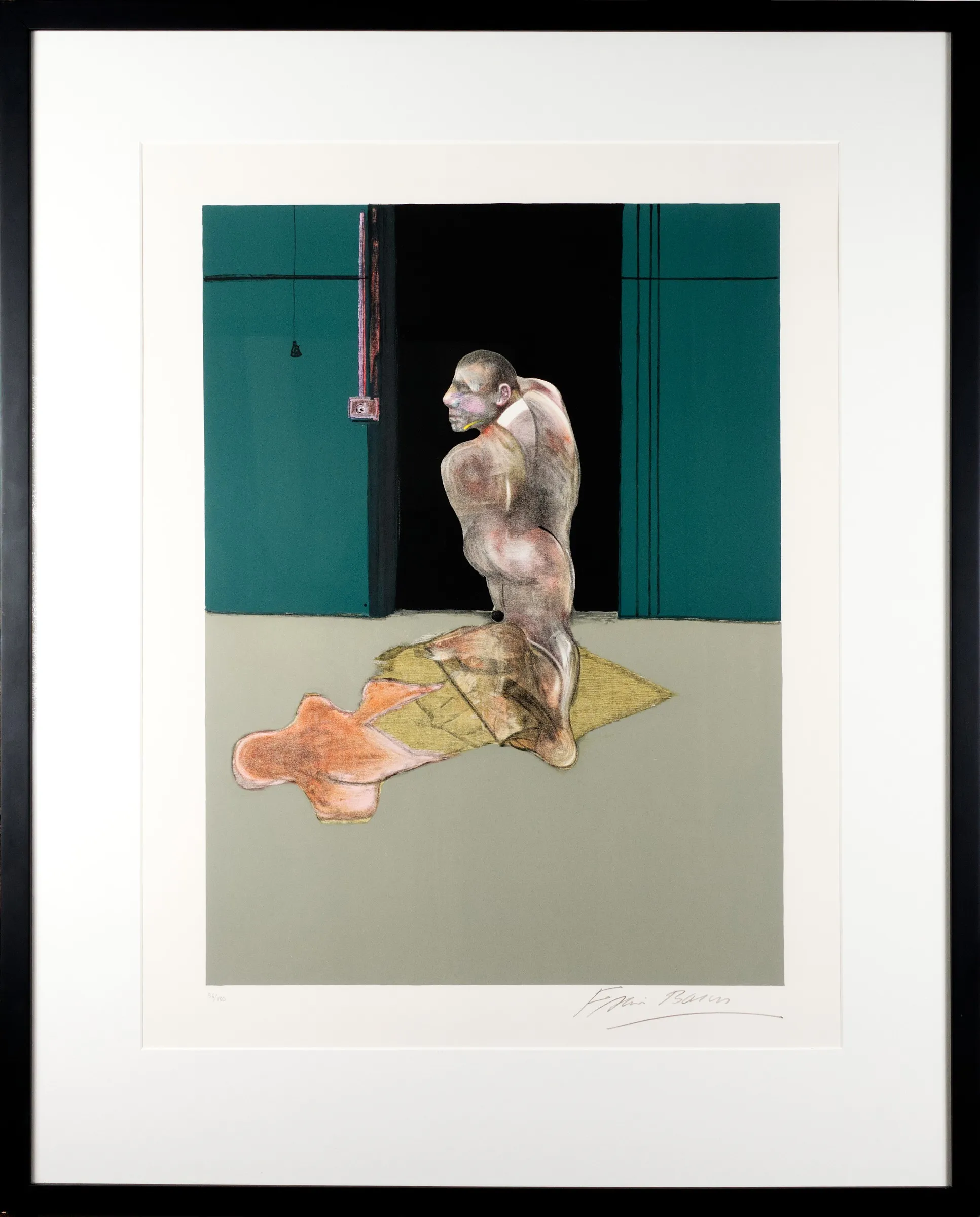
Francis Bacon was one of the most compelling painters of the twentieth century, whose images of the human figure combine emotional intensity with extraordinary painterly invention. His portraits and triptychs explore the physical presence of the body, the instability of identity and the vulnerability of human existence.
Born in Dublin in 1909, Bacon developed his practice largely outside formal art education. Drawing on Old Master paintings, photography, cinema and personal experience, he created a distinctive visual language in which recognisable figures appear transformed, isolated or caught in motion.
Sweeping curves, architectural frameworks and vivid fields of colour give structure to his compositions, setting passages of expressive paint against precisely organised surroundings. Beneath their unsettling imagery lies a sustained attention to the people and experiences that shaped his life. Bacon’s work remains a powerful exploration of how painting can convey sensation, presence and the complexity of being human in the modern world.
Available Artworks
Francis Bacon: Life and Work
Early Life and Artistic Development
Born in Dublin in 1909 to English parents, Francis Bacon spent his childhood between Ireland and England. As a young man, he travelled to London, Berlin and Paris, encountering different artistic and cultural environments.
Largely self-taught, he initially worked in interior decoration and furniture design before establishing his commitment to painting. An encounter with Picasso’s work in Paris in 1927 helped reveal the expressive possibilities of transforming the human figure.
Bacon’s development was gradual and exacting. He destroyed many early paintings, retaining only a small proportion of the work through which he arrived at his mature approach.
A Distinctive Post-war Vision
Three Studies for Figures at the Base of a Crucifixion (1944), first exhibited in London in 1945, marked a decisive moment in Bacon’s career. Its three distorted creatures, set against an intense orange background, announced a disturbing and unmistakable artistic presence.
The work brought together references to religious painting and classical tragedy without offering a conventional narrative. Its force lies in the bodily tension of the figures and the contrast between their strange anatomy and the clarity of their surroundings.
The human figure subsequently became the centre of Bacon’s practice. Whether seated, reclining or caught in movement, his subjects possess a physical immediacy that makes their vulnerability difficult to overlook.
Influences: Painting, Photography and Film
Bacon drew on an unusually broad range of visual sources. Paintings by Velázquez and Rembrandt existed alongside photographs, medical illustrations, newspaper images and film stills within his imaginative world.
Velázquez’s portrait of Pope Innocent X became a recurring point of departure. Bacon transformed the authority and composure of the original into images in which the figure appears unstable, enclosed or overwhelmed.
Eadweard Muybridge’s photographs of bodies in motion and imagery from Sergei Eisenstein’s films offered further possibilities for describing movement and expression. These sources were absorbed and transformed rather than simply reproduced, becoming elements in a deeply personal pictorial language.
Portraiture and Personal Relationships
Friends and partners provided many of Bacon’s most enduring subjects. George Dyer, Isabel Rawsthorne, Henrietta Moraes and Lucian Freud recur across paintings that combine familiarity with radical transformation.
Photographs, including those taken by John Deakin, allowed Bacon to work at a distance from his sitters. Features could be shifted, compressed or swept across the canvas while retaining a compelling sense of individual presence.
These portraits seek more than a stable likeness. Through changes of viewpoint and the movement of paint, they suggest the experience of encountering a person whose appearance and emotional character cannot be contained in a single description.
Triptychs, Space and the Painted Surface
The triptych became one of Bacon’s most important formats. Three panels allowed him to place related figures or moments beside one another while leaving their connections unresolved.
Within individual canvases, curved rooms, platforms and fine linear frameworks organise the space around the body. These structures direct attention towards the figure, heightening its isolation or suggesting an arena in which an encounter is unfolding.
Bacon’s handling of paint contributes equally to this tension. Broad areas of flat colour sit beside dense, textured passages, while sweeping marks can disrupt a face or limb. Control and chance remain closely entwined, giving the surface an energy that resists complete explanation.
Major Exhibitions and International Recognition
Bacon’s reputation grew through exhibitions that established him as a central figure in post-war painting. A major retrospective at the Tate Gallery in 1962 brought together his developing achievement, including the ambitious Three Studies for a Crucifixion painted that year.
The retrospective at the Grand Palais in Paris in 1971 confirmed his international standing. A further Tate retrospective in 1985 offered another substantial survey of a practice that continued to develop through repeated subjects and increasingly assured handling.
These exhibitions demonstrated the breadth within Bacon’s concentrated attention to the figure: portraiture, movement, intimacy and the relationship between the body and its surroundings.
Museum Collections, Studio and Legacy
Bacon’s paintings are held in major public collections internationally. Tate holds Three Studies for Figures at the Base of a Crucifixion, while the Museum of Modern Art in New York holds Painting (1946).
His Reece Mews studio, preserved and reconstructed at the Hugh Lane Gallery in Dublin, provides an exceptional record of his working environment. Photographs, books, source material and painting equipment reveal the accumulation of images and objects that fed his practice.
Bacon died in Madrid in 1992. His enduring contribution lies in the conviction that the human figure could remain a source of radical artistic invention. Through distortion, colour and the physical possibilities of paint, he created images that continue to challenge how we understand likeness, emotion and human presence.
Enquiries
For more information about Francis Bacon’s work and available artworks, please contact the gallery.