Desmond Morris
Desmond Morris was a British Surrealist artist whose imagined creatures and otherworldly settings reveal a lifelong fascination with living forms. Alongside his international reputation as a zoologist, author and broadcaster, he developed an independent artistic practice rooted in invention, instinct and the possibilities of the unconscious.
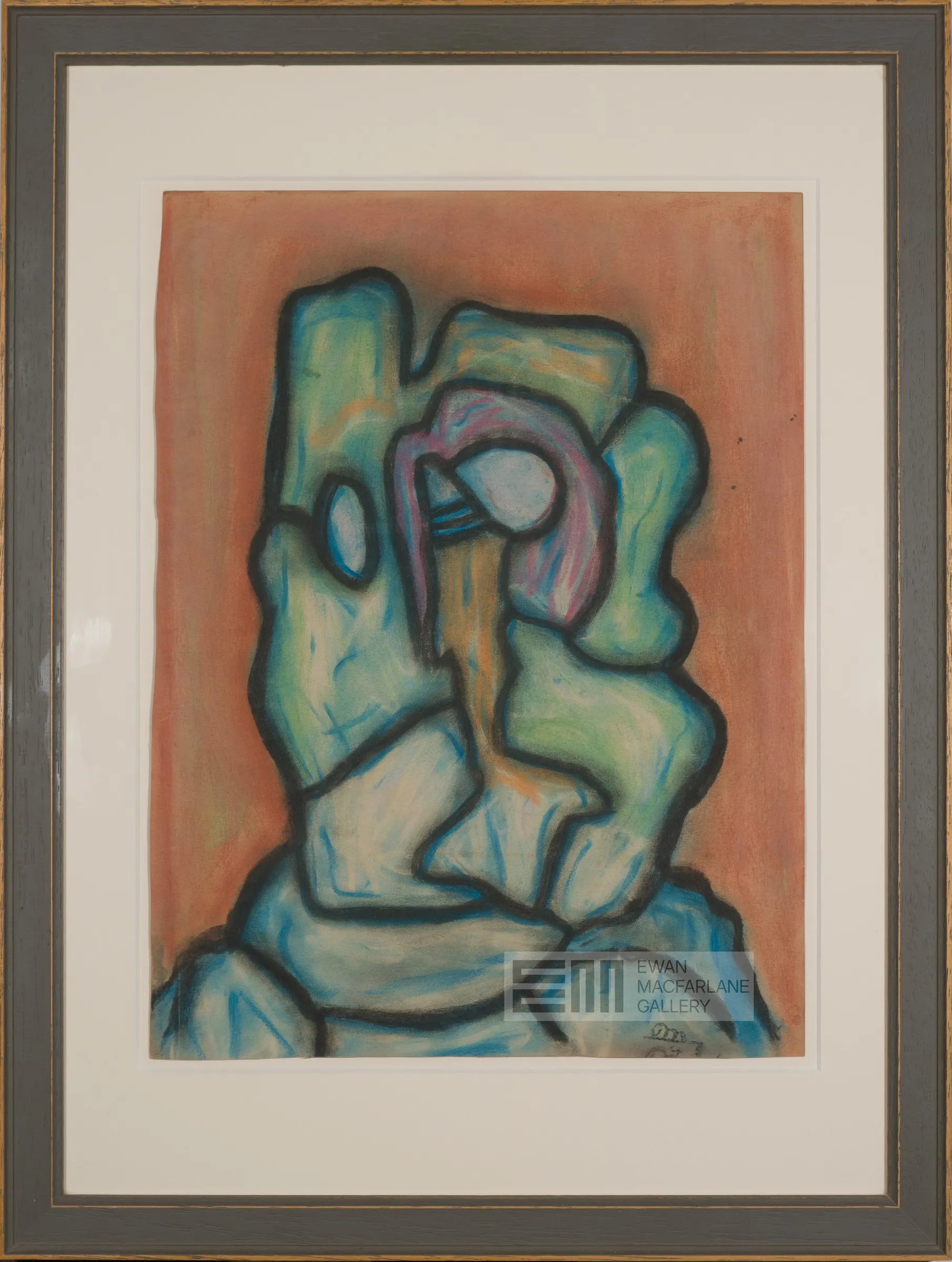
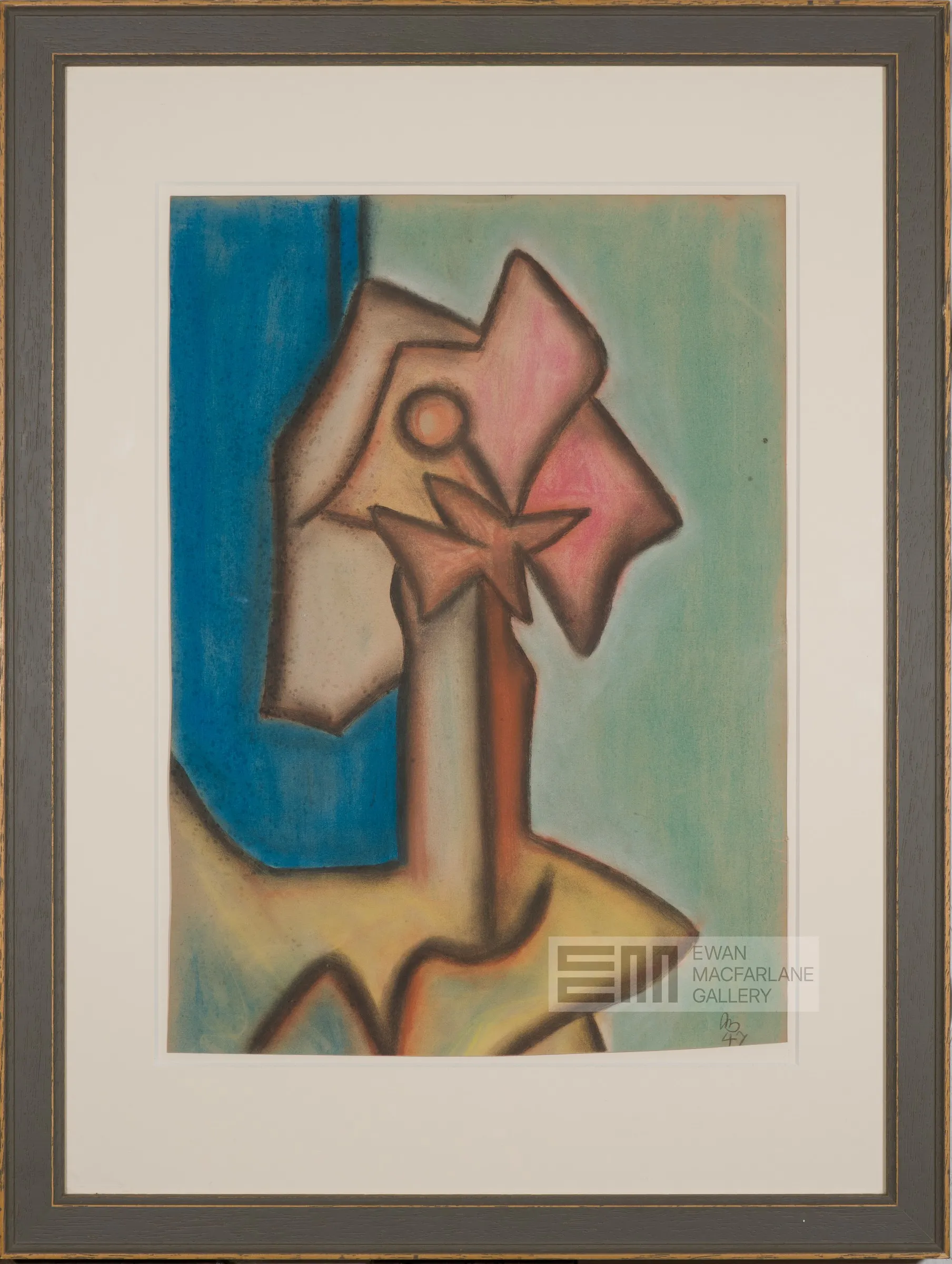
Born in Wiltshire in 1928, Morris held his first solo exhibition in 1948 and showed alongside Joan Miró at the London Gallery in 1950. His distinctive visual language centres on biomorphic forms: shapes that suggest living organisms without belonging to any recognisable species.
Playful, enigmatic and occasionally unsettling, these beings inhabit a world governed by its own relationships and tensions. His paintings and drawings invite viewers to discover familiar gestures and emotions within unfamiliar bodies. Bringing together scientific curiosity and imaginative freedom, Morris created a personal contribution to British Surrealism, exploring the boundary between the natural world and the creatures of the mind’s eye.
Available Artworks
Desmond Morris: Life and Work
Early Life and Artistic Development
Born in Purton, Wiltshire, in 1928, Desmond Morris developed interests in both animals and art from an early age. Painting offered a means of creating an imagined world, while his scientific curiosity encouraged close observation of the world around him.
The artist and critic Mervyn Levy supported his early development, and Morris held his first solo exhibition at Swindon Public Library in 1948. His encounters with the Birmingham Surrealist Conroy Maddox subsequently strengthened his commitment to a form of art liberated from literal description.
For Morris, Surrealism provided an opportunity to invent forms and relationships that could exist beyond the constraints of everyday experience.
British Surrealism and Early Exhibitions
Morris entered the British Surrealist circle while studying zoology at the University of Birmingham. In 1950, his work appeared alongside that of Joan Miró at the London Gallery, in an exhibition organised by the Belgian Surrealist E. L. T. Mesens.
This early exposure placed his work within an established network of artists committed to the imagination, unexpected associations and the exploration of unconscious thought.
His experiments also extended to moving images. In 1950, he wrote and directed two Surrealist films, Time Flower and The Butterfly and the Pin, bringing his imaginative interests into another medium.
Biomorphic Forms and Imagined Creatures
At the centre of Morris’s art are biomorphs: invented forms that resemble living things without depicting identifiable animals or plants.
Their bodies may suggest limbs, organs, shells or microscopic structures, yet resist a single interpretation. They appear to possess their own anatomy and behaviour, encouraging viewers to imagine how they might move, interact or survive.
These creatures can seem humorous or vulnerable, affectionate or threatening. Their ambiguous character gives the work much of its emotional range. An unfamiliar shape may evoke a surprisingly recognisable encounter, gesture or relationship.
Through this invented population, Morris developed a visual language in which organic form becomes a vehicle for exploring instinct and feeling.
Science, Behaviour and Imagination
Morris’s scientific career developed alongside his painting. After studying zoology at Birmingham, he completed a doctorate at Oxford under the animal behaviour specialist Niko Tinbergen.
His subsequent work as an author and broadcaster brought the study of behaviour to a wide audience, notably through The Naked Ape, published in 1967.
Science and painting offered different approaches to his fascination with life. Scientific research required attention to observable behaviour; art allowed him to imagine organisms and situations unconstrained by evidence.
His investigations into picture-making by apes brought these interests into particularly close contact. In 1957, he organised an exhibition of paintings by chimpanzees at London’s Institute of Contemporary Arts, raising questions about creativity and the origins of image-making.
A Sustained Artistic Practice
Although his public reputation often centred on zoology and writing, painting remained an important part of Morris’s life.
A return to exhibiting in the 1970s brought renewed attention to his art. A retrospective at Swindon’s public art gallery in 1976 surveyed three decades of painting, placing his early Surrealist experiments within a developing body of work.
Later exhibitions and publications explored the consistency and variety of his imagined world. Across changing compositions and techniques, the biomorph remained a recurring presence: a form through which he could continually discover new possibilities.
Museum Collections, Exhibitions and Legacy
Morris’s work has been presented in both public institutions and specialist galleries. His exhibition history includes the Ashmolean Museum in Oxford, a retrospective at Swindon, and subsequent exhibitions at the Mayor Gallery and the Redfern Gallery in London.
The National Galleries of Scotland holds War Woman (1949), an early mixed-media construction that combines everyday objects into an unsettling figure. The work demonstrates how his imagination extended beyond painted imagery into the transformation of physical materials.
Morris died in 2026. His artistic achievement offers a distinctive perspective within British Surrealism: an invented natural history populated by creatures that remain strange in appearance yet familiar in their suggestion of life, instinct and emotion.
Enquiries
For more information about Desmond Morris’s work and available artworks, please contact the gallery.